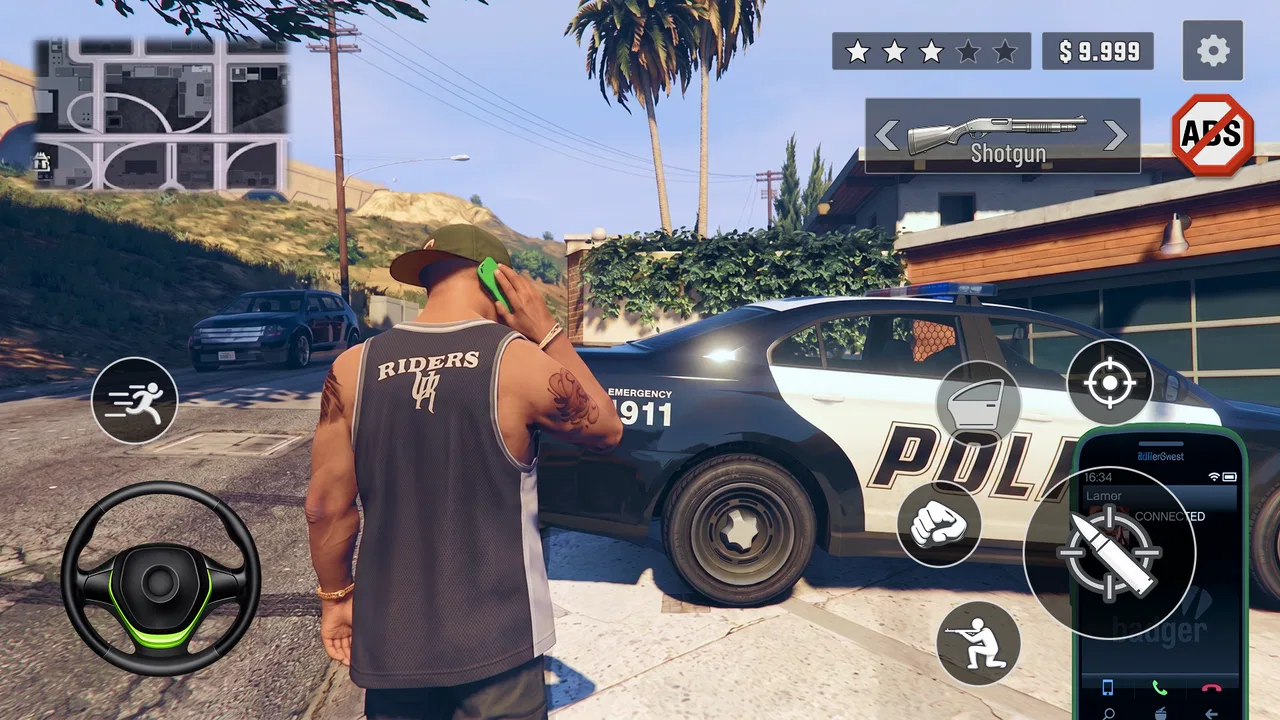
Real Gangster: Open World 3D
- 4.5
- Rating
- 1.00M
- Installs
- Free
- Price

 Analysis by App-foxy
I went into Real Gangster: Open World 3D expecting a quick open-world action game, and that is exactly where its appeal begins. It puts the emphasis on immediate movement and trouble rather than asking me to learn a complicated role-playing system first. The result feels best when I want a short burst of action: start playing, create a little chaos, react to what happens, and decide whether the next attempt can go further.
This is a free role-playing game from MohammedFayed, aimed at a mature audience. Its age rating is Mature 17+, so I would not treat it as a family-friendly game simply because it is easy to start. The current version is 0.0.6, and the game has already passed one million installs with a 4.7 average from around 4.2 thousand ratings. Those figures suggest that its straightforward concept is reaching plenty of players, but they do not remove the need to decide whether this particular style of open-world action suits you.
What happens when I start playing
The first useful thing about this game is that it does not make me wait long for the main idea. I can get into the world and focus on movement, confrontation, and the consequences of pushing my character into risky situations. That quick start matters on a phone, where I may only have a few minutes before putting the device down.
You May Also Like

 Blood Strike: 2.5 Anniversary
Blood Strike’s Loadouts Turn Every Drop Into a Tactical Gamble
A close look at Blood Strike’s custom loadouts: how fast access to signature weapons reshapes its battle royale rhythm, rewards preparation, and narrows the gap between fights.

 Pandora - Music & Podcasts
Pandora’s Music Is Easy to Start, but Harder to Recover
Pandora’s strength is its low-effort path from a seed to a station. Its weak spot is how much confidence it asks you to place in connection, setup, and quiet recovery.

 8 Ball Pool
 Is Built on Rivalries, Rematches, and Routine
A close look at the rivalries, rematches, shared routines, and unanswered safety questions that turn a quick pool match into a persistent mobile community.

 Samsung Music
’s Quiet Strength Is Playing What You Already Own
Its reach comes less from spectacle than from dependable access to a personal library. That simplicity is both the app’s strongest retention engine and its ceiling.

 AccuWeather: Weather Radar
AccuWeather Review: A Quick, Clear Forecast for Everyday Decisions
For everyday plans, the best forecast is the one you can understand quickly. AccuWeather makes rain timing, radar, and local conditions easy to act on, with a few trade-offs.

 Hill Climb Racing
Why Hill Climb Racing Still Turns Crashes Into One More Run
A tiny car, a bumpy hill and one more upgrade: Hill Climb Racing keeps resurfacing because its simple chaos makes every near-miss feel personal.
More From Our News Desk
View All News


The opening action is also a good test of whether the game matches your taste. If you enjoy open spaces, aggressive encounters, and the feeling that a simple decision can turn into a larger problem, the basic setup is easy to understand. If you prefer a carefully guided role-playing adventure with long conversations, deep party management, or a heavily scripted story, this is probably not the right first choice.
I found the game more enjoyable when I treated the early minutes as a learning period instead of trying to play perfectly. The useful question is not only whether I can win an encounter, but whether I understand what caused the situation to escalate. That mindset makes the action feel less random and gives each restart a purpose.
Because the game is still at version 0.0.6, I would approach it as an evolving experience rather than a finished, content-heavy role-playing epic. That is not automatically a problem. It simply changes the expectation: the strongest reason to play is the immediate open-world action loop, not the promise of a huge, polished campaign with every system fully developed.
The first few minutes reward direct experimentation
My practical advice is to spend the first session testing the controls and the space around you before committing to the most dangerous situation available. On a touchscreen, small movement errors can matter more than they would with a controller. Learning how the character responds, how quickly I can reposition, and when to stop pressing forward makes later encounters less frustrating.
This is one of the less obvious strengths of the game: the opening can be used as a calibration exercise. Instead of wasting the first attempt by treating every encounter as a final battle, I can use it to discover which actions feel reliable. That approach is especially helpful for players moving from slower role-playing games into a more immediate action format.
The trade-off is that players who want a strong tutorial may feel left to work things out through trial and error. I personally prefer some discovery, but I can see why a newcomer might want clearer guidance. The game works best for someone willing to learn by doing, not for someone who expects every rule to be explained before the first serious decision.
Why the action feels better in short bursts
The open-world setting gives the game a sense of possibility, but I would not confuse openness with unlimited depth. The world is most useful as a stage for action and experimentation. I enjoy it when I have a simple goal for the session, such as testing a route, provoking a confrontation, or seeing how long I can keep control of a difficult situation.
That makes it a natural fit for a commute, a break between tasks, or an evening when I want something more active than a puzzle but less demanding than a long story game. I can play without needing to remember a complicated plot from the previous night. The downside is that players looking for a strong narrative reason to return may find the moment-to-moment action more convincing than the larger role-playing structure.
The feedback rhythm: action, reaction, and adjustment
The central rhythm is easy to describe: I act, the world reacts, I deal with the result, and then I decide whether to continue or reset. That rhythm is the heart of the experience. It gives the game a reason to keep me engaged even when a session does not end in a clear victory.
Good action games make feedback readable. I need to understand whether a risky move helped, made things worse, or simply created a new problem. In this game, the satisfaction comes from connecting my choices with the next change in the situation. When that connection is clear, even a failed attempt can feel useful rather than wasted.
The feedback is strongest when I slow down enough to notice patterns. Charging into every encounter may produce immediate excitement, but it also removes the chance to learn. Watching how a situation develops, choosing when to push, and recognizing when a retreat is smarter gives the open-world format more texture than constant forward movement.
Risk is more interesting than simple success
One of my favorite ways to approach the game is to treat danger as a resource-management question, even if I am not managing a traditional role-playing inventory or party. Every aggressive decision spends some of my control over the session. If I keep escalating, I may reach a more exciting moment, but I also make a reset more likely.
This creates a useful tension between safety and curiosity. A cautious player can preserve a good run, while an adventurous player may discover more dramatic situations by accepting greater risk. Neither approach is automatically correct. The important point is that the game gives me a reason to make the choice consciously instead of wandering without a plan.
That is also where the mature rating matters in practical terms. The tone is built around criminal action and confrontation, so I would not recommend it to younger players or to anyone seeking a relaxed, nonviolent open-world experience. Adults who are comfortable with that subject matter will understand the intended mood quickly.
A realistic everyday session
Imagine having ten minutes before leaving for work. I can start the game, use the first minute to get oriented, and then attempt one deliberate challenge rather than trying to complete a long chain of objectives. If the situation goes well, I have a satisfying short run. If it falls apart, I have still learned which decision caused the trouble. I can close the game without feeling that I abandoned a complicated story at the wrong moment.
Later, I can return with one small experiment in mind. Perhaps I will take a different approach to the same kind of confrontation, move more carefully, or stop earlier instead of turning a manageable encounter into a collapse. That repeatable structure is more valuable to me than a large checklist of activities, because it gives short sessions a clear shape.
Where mobile controls can create friction
Touch controls always introduce a compromise in an action game. Even when the layout is understandable, my fingers can cover part of the screen, and quick movement may feel less exact than it would with physical buttons. This matters most during stressful encounters, when a small mistake can change the outcome.
I recommend playing with a light touch and avoiding unnecessary movements. On a smaller phone, keeping the device steady can be as important as choosing the right action. If you have access to a larger screen, the extra space may make the world easier to read, but I would still expect a learning curve before the controls feel natural.
This is a clear situation where another option may be better. If your priority is precise competitive combat, a dedicated controller-friendly game will probably give you more dependable input. If your priority is quick, accessible open-world action on a phone, the trade-off is easier to accept.
The reward: why another attempt feels worthwhile
The reward in this game is not only reaching a destination or surviving an encounter. I get satisfaction from understanding the situation better than I did during the previous attempt. The game becomes more engaging when I can point to a specific improvement: I reacted earlier, avoided a needless escalation, or recognized that continuing was a bad bargain.
That kind of reward is easy to overlook because it is not always presented as a dramatic achievement. It is the feeling that the next session may go differently because I now know something. For an open-world action game, that is a sensible form of progression. The world provides the pressure, and my growing familiarity provides the improvement.
I also like that the action can create its own stories. A short run may begin calmly and then become memorable because one decision changed everything. Those moments are more personal than a fixed cutscene because they come from the way I played. The game is at its best when it lets me remember a situation rather than merely complete a task.
Who will get the most from the loop
I would recommend it to players who enjoy experimenting, restarting, and creating their own objectives inside an open environment. It suits someone who wants a free mobile role-playing game with an action-first identity and does not need a long explanation before getting involved.
It is also a good match for players who like replayability built from decisions rather than from collecting every possible item. You may enjoy it if your favorite question is, “What happens if I try this now?” rather than, “Which dialogue choice unlocks the next chapter?”
I would skip it if you need a calm game, a strongly structured narrative, or a deep character-building system with carefully explained statistics. I would also be cautious if you dislike mature criminal themes or become frustrated when touchscreen action requires practice. The game’s directness is its main appeal, but that same directness can feel limited to someone looking for a broader role-playing package.
How it compares with familiar alternatives
Compared with story-led role-playing games, this one puts less pressure on remembering characters, quests, and plot details. I can return after several days and still understand the immediate goal: move through the world, take action, handle the reaction, and try again if the run breaks down.
Compared with purely arcade action games, it offers a more open setting and a stronger sense that my decisions shape the session. However, players expecting the depth of a large console-style open-world game should keep their expectations measured. The experience is better understood as a compact mobile action playground than as a direct replacement for a major, story-rich production.
That middle position is important. It gives the game a practical identity: more flexible than a linear action stage, more immediate than a traditional role-playing adventure, and easier to sample than a long campaign. Whether that is enough depends on what you want from your phone. For me, it works when I value quick engagement over extensive complexity.
Resetting the session without losing the lesson
A reset is not merely a failure screen in this kind of game. It is the point where I decide what to carry into the next attempt. If I restart immediately without thinking, the loop can become repetitive. If I take a moment to identify the turning point, the next session has a clear experiment attached to it.
I found that the most useful resets were not always the ones caused by the biggest mistake. Sometimes a run became less enjoyable because I continued after the situation had already stopped being manageable. That taught me to treat withdrawal as a valid decision rather than as proof that I had played badly.
This is a valuable habit for mobile play. A short session does not need to end with a perfect result. It can end with one practical conclusion: a route was too risky, an aggressive choice happened too early, or a safer approach gave me more control. That keeps the game from becoming a sequence of empty restarts.
Small habits that improve repeat sessions
- Choose one experiment per run. Testing too many decisions at once makes it difficult to understand what actually improved.
- Use the opening minutes to read the situation. Immediate action is tempting, but a brief orientation can prevent a careless reset.
- Notice the moment control begins to slip. Continuing for excitement can be worthwhile, but do it knowingly rather than by accident.
- Change one habit after a failed attempt. A different route, timing, or level of aggression is more useful than repeating everything unchanged.
These habits do not turn the game into a complex strategy title, and they should not be treated as mandatory rules. They simply make the action loop more rewarding. The game gives me enough freedom to create my own structure, so a little self-discipline helps reveal more value than random wandering.
What the free price means for the decision
The game is free, which lowers the barrier to trying it. I can install it and quickly determine whether the action style works for me without committing to a purchase. That is especially useful here because the right audience is quite specific: players who enjoy mature open-world confrontation and repeated experimentation will know fairly quickly whether they are interested.
Free does not mean every player will find it satisfying. The absence of an upfront cost cannot replace a polished long-term progression system, and players who want a complete premium-style adventure may still prefer a paid alternative with a more deliberate campaign. In this case, the price makes sampling easy, while the short-session loop determines whether I keep returning.
The game’s popularity is another reason it may be worth testing, but I would not use the number of installs or its 4.7 average as a substitute for personal fit. Ratings can tell me that many players respond well to the concept; they cannot tell me whether I will enjoy touchscreen combat, the mature tone, or the relatively direct structure.
My verdict on the complete loop
Real Gangster: Open World 3D works because its main cycle is understandable without being completely empty. I take an action, receive a reaction, decide whether to push further, and then either enjoy the result or reset with a better idea. The reason to begin another session is not just the possibility of winning; it is the chance to handle the same kind of pressure more intelligently.
My strongest recommendation is to play it in focused bursts. Give each session a small purpose, pay attention to what changes after your decisions, and avoid judging the game only by whether a run ends successfully. That approach brings out the open-world freedom while reducing the frustration caused by uncontrolled escalation.
I would choose this over a conventional role-playing game when I want immediate action and a flexible mobile session. I would choose something else when I want a deep story, precise competitive controls, or a carefully layered progression system. The game does not need to satisfy all of those audiences. Its value comes from being direct, replayable, and easy to return to.
For me, the final verdict is positive but measured. The free entry point, mature open-world action, and restart-friendly structure make it worth trying for the right player. Its current version also encourages realistic expectations: enjoy the core loop, judge the controls for yourself, and decide whether the feedback from one session gives you a genuine reason to start the next.
FAQs for Real Gangster: Open World 3D
01What is Real Gangster: Open World 3D?
Real Gangster: Open World 3D is an action game built around free-roaming criminal adventures in a large 3D city. After starting the game, you can explore streets, drive vehicles, take on missions, and participate in battles with rival gangs or police forces. Its main appeal is the open-world format, which lets you move around and enjoy activities beyond the central objectives.
02Can I play Real Gangster: Open World 3D offline?
The game is generally designed as a single-player experience, so many of its core features can be enjoyed without creating an account or competing with other players online. However, availability of advertisements, updates, optional rewards, or certain services may depend on an internet connection. It is best to launch the game once while connected and check its current requirements on your device.
03Is Real Gangster: Open World 3D suitable for children?
Real Gangster: Open World 3D focuses on crime-themed action, including firearms, vehicle pursuits, fighting, gang conflicts, and police encounters. Because of these mature themes and arcade-style violence, it may not be appropriate for young children. Parents should review the store rating, screenshots, permissions, and advertising content before allowing a child to install or play it.
04Does the game contain ads or in-app purchases?
Like many free mobile action games, Real Gangster: Open World 3D may use advertisements to support development, and it can potentially include optional purchases depending on the version distributed through your app store. Ads may appear between activities or after completing missions, while purchases can sometimes speed up progression. Always review the store listing and payment settings before downloading.
05What devices are needed to run Real Gangster: Open World 3D smoothly?
The game uses a 3D open-world environment with vehicles, characters, combat, and a city map, so performance depends on your phone or tablet’s processor, graphics hardware, available memory, and storage space. Older or entry-level devices may experience slower loading, frame-rate drops, or heating. Keep the operating system updated, close background apps, and install the latest official version for the best experience.
Pros
- Large open-world map to explore freely.
- Simple controls make driving and shooting easy to learn.
- Varied missions provide action beyond free roaming.
- Playable offline
- with no constant internet connection required.
- Low device requirements make it accessible on many phones.
Cons
- Frequent ads can interrupt gameplay and exploration.
- Graphics look dated compared with newer open-world games.
- Vehicle handling feels loose and sometimes difficult to control.
- Mission objectives can become repetitive after extended play.
- In-app purchases may be needed to progress more comfortably.

Real Gangster: Open World 3D
Gallery